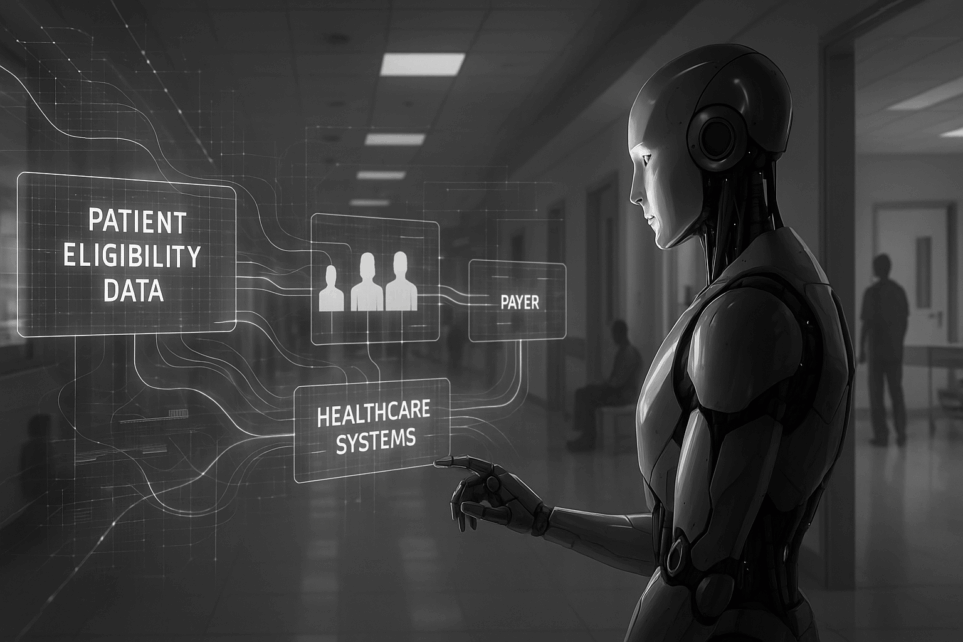


AI-Powered Revenue Cycle Transformation in Healthcare
AI is revolutionizing the Healthcare industry including Revenue Cycle Management (RCM) and Medical Billing.


Hospitals today are under escalating pressure on both operational efficiency and financial performance. Front-end processes such as eligibility verification, which involves confirming a patient’s insurance coverage, benefits, and financial responsibility before service delivery, represent one of the most persistent pain points in the revenue cycle.
Manual verification workflows are time-consuming, error-prone, and prone to claim denials, delayed reimbursements, and administrative overhead. These inefficiencies are now being redefined by AI. Artificial intelligence (AI) offers a strategic leap in this domain by automating the verification process, embedding predictive analytics, and enabling staff to focus on higher-value activities. This is why hospitals are increasingly investing in AI powered eligibility verification systems.
Eligibility verification forms a critical gatekeeper in the revenue cycle: if coverage is incorrect, the claim may be denied or delayed, patient liability may be mis-estimated, and administrative costs rise.
According to an analysis of AI in Revenue Cycle Management (RCM), 72 % of healthcare leaders identified eligibility and benefits verification as one of the most promising areas for AI application, rather than current usage.
The CAQH Index 2023 also estimated that automating eligibility and benefits verification is among the largest administrative cost-saving opportunities in U.S. healthcare, contributing to billions in potential annual savings when combined with other revenue-cycle transactions.
Delays in verification also disrupt patient access and increase the chance of downstream revenue leakage. These risks incentivize hospitals to adopt smarter, automated solutions.
AI-powered solutions transform eligibility verification in several ways:
Real-time coverage and benefit checks: AI systems can query payer databases or portals, validate policy status, effective dates, benefit limits, deductibles/co-pays, and flag gaps or mismatches before service is rendered. Studies show this dynamic verification supports faster and cleaner claims.
Error reduction & predictive flagging: Traditional manual approaches often miss nuanced eligibility aspects (for example, secondary coverage or prior-authorization requirements). AI models can flag anomalies or high-risk cases ahead of billing. The Change Healthcare “Poised to Transform” report found eligibility and benefits verification to be one of the top AI use cases hospitals plan to expand.
Workflow integration & scalability: AI enables verification at scale and upstream (before patient arrival), which helps reduce the burden on intake staff and minimize billing surprises. Industry guidance recommends completing eligibility verification before the patient visit to prevent billing delays and reduce administrative friction, though no specific hourly window is prescribed.
Improved patient financial transparency: With more accurate eligibility data up front, hospitals can provide clearer cost estimates, reduce patient surprise bills, and enhance the financial experience. This benefit appears in multiple automation studies.
Together, these capabilities reduce risk of denied claims, shorten time to payment, and free staff from repetitive verification tasks.
Hospitals are making strategic investments in AI-driven eligibility verification for several reasons:
● According to the Change Healthcare “Poised to Transform” report, 65 % of healthcare organizations already reported using AI in RCM, and 72 % cited eligibility and benefits verification as a leading area for AI application.
● Industry guidance indicates that automation of eligibility verification is becoming a baseline expectation in hospital revenue-cycle operations, given rising labor cost, payer complexity, and patient financial responsibility.
● Press coverage (e.g., MedCity News, 2025) highlights that verifying eligibility and integrating payment collection ahead of the visit is now seen as a competitive differentiator for hospitals.
These drivers point to a convergence of clinical access and financial imperatives: hospitals need faster, accurate front-end workflows to stabilize revenue and improve patient experience.
By investing in AI-powered eligibility verification, hospitals can realize:
● Reduced claim denials at the first pass by ensuring coverage and benefits are validated before service.
● Shorter accounts-receivable (A/R) cycles because claims start clean and payment flows faster.
● Lower administrative cost and burden, since manual verification tasks are reduced or shifted to oversight rather than full execution.
● Enhanced patient experience, with fewer surprises in billing and clearer financial communication upfront.
● Improved operational scalability, enabling hospitals to handle higher patient volumes without linear increases in verification staff.
Each of these benefits supports improved financial performance, operational efficiency, and patient satisfaction, forming a compelling triad as hospitals face margin pressures and workforce scarcity.
Even though AI offers significant benefits, hospitals must approach implementation thoughtfully to achieve desired outcomes:
● Data quality and integration: AI verification systems depend on accurate patient, payer, and coverage data, and must integrate with EHRs and billing systems. As one industry review notes, success of RCM AI hinges on health-information-professional/physician partnerships and reliable data.
● Change management and staff training: Verification workflows shift from manual to automated, and staff must be upskilled to validate exceptions rather than execute all tasks.
● Governance and compliance: Automated eligibility checks must align with HIPAA privacy rules, payer contracts, and audit readiness.
● ROI measurement: Hospitals should define baseline verification metrics (for example, verification turnaround time, denial rate due to eligibility, A/R days) and measure improvement post-deployment.
● Scalable deployment: Starting with high-volume service lines or high-denial-risk payers may yield quick wins; subsequent rollout can broaden.
An AI-verification project should be positioned not as a standalone tool but as a component of a comprehensive, data-centric front-end strategy.
As hospitals continue to modernize their revenue cycle, the ability to validate coverage accurately and instantly is becoming a competitive necessity. Manual and semi-automated processes can no longer keep up with the speed, accuracy, and data depth required in today’s payer landscape. This is where Intelligent HealthTech (IHT) plays a pivotal role.
IHT’s AI-powered eligibility verification solutions are designed to close existing gaps between patient registration and payer validation. By combining real-time eligibility checks, automated data enrichment, and intelligent denial prevention, IHT helps hospitals eliminate costly rework, accelerate reimbursements, and improve patient financial transparency.
Through predictive analytics and adaptive automation, IHT enables healthcare providers to detect potential coverage conflicts early, streamline verification workflows, and ensure every claim starts clean. The result is a faster, more accurate, and more patient-friendly revenue cycle that positions hospitals for long-term resilience and growth. Hospitals are investing in AI-powered eligibility verification because it addresses one of the most critical pain points in the revenue cycle: the risk and cost associated with upfront coverage confirmation.
By automating eligibility checks, integrating predictive analytics, and improving data accuracy before care is delivered, hospitals can reduce denials, shorten reimbursement cycles, scale operations, and enhance the patient’s financial experience.
The strategic investment in AI at this front-end lever pays dividends not just in financial metrics but in operational resilience and patient satisfaction. As complexity, patient responsibility, and payer friction grow, eligibility verification is evolving from an administrative task into a strategic differentiator, and AI is its enabler.
1. CAQH Index 2023 Report – https://www.caqh.org/hubfs/43908627/drupal/2024-01/2023_CAQH_Index_Report.pdf
2. Experian Healthcare –https://www.experian.com/blogs/healthcare/insurance-eligibility-checks-how-automation-reduces-denials-and-delays/
3. American College of Healthcare Executives / Change Healthcare – https://www.ache.org/-/media/ache/about-ache/corporate-partners/change-healthcare-aircm-research-study-ebook.pdf
4. Thoughtful AI – https://www.thoughtful.ai/blog/how-automated-eligibility-verification-improves-healthcare-efficiency
5. HIMSS – https://www.himss.org/resources/ai-in-healthcare/
6. Access Healthcare – https://www.accesshealthcare.com/s/The-Future-of-AI-and-Automation-in-Revenue-Cycle-Management_V4.pdf
7. MedCity News –
https://medcitynews.com/2025/02/automating-insurance-verification-a-game-changer-for-pre-visit-payment-collection/
8. AHIMA Journal – https://journal.ahima.org/page/success-of-revenue-cycle-ai-hinges-on-health-information-physician-partnerships

AI is revolutionizing the Healthcare industry including Revenue Cycle Management (RCM) and Medical Billing.

AI technologies are being effectively used to automate various aspects of the RCM processes to maximize revenue collection and achieve financial success.

AI-powered RCM capabilities include automation of eligibility and benefits verification, prior authorization, claims scrubbing, claims processing, medical coding, patient collections, payment posting and reconciliation, denial management and AR follow-up.
Copyright ©2025 Intelligent HealthTech. All rights reserved.
